
In the fast-paced world of consumer insights, "traditional" and "qualitative" are often synonymous with "slow." While quantitative data gives us the what, qualitative research provides the why. However, the manual labor required to analyze hundreds of hours of video or ethnography often means that by the time the insights are ready, the market has already moved on.
At Streamingo, we are bridging this gap. By utilizing advanced AI and Computer Vision, we are transforming qualitative research from a bottleneck into a competitive advantage.
The Problem: The "Silent Cost" of Manual Analysis#
Traditional qualitative research suffers from three primary friction points:
The Time Lag
Researchers spend 60–70% of their time "coding" video — manually tagging moments where a participant opens a fridge, smiles, or pauses in frustration. This is time not spent thinking, strategizing, or generating insight.
Subjectivity
Human fatigue leads to inconsistent tagging across long datasets. What one analyst codes as "frustrated" at hour one, they may code as "neutral" at hour six. This variability corrupts the reliability of findings.
Opportunity Cost
Because analysis is so slow, companies often sample only a tiny fraction of their collected footage, leaving up to 90% of "dark data" unexamined. The most important consumer moments may never even be seen.
The Solution: An AI "Exoskeleton" for Researchers#
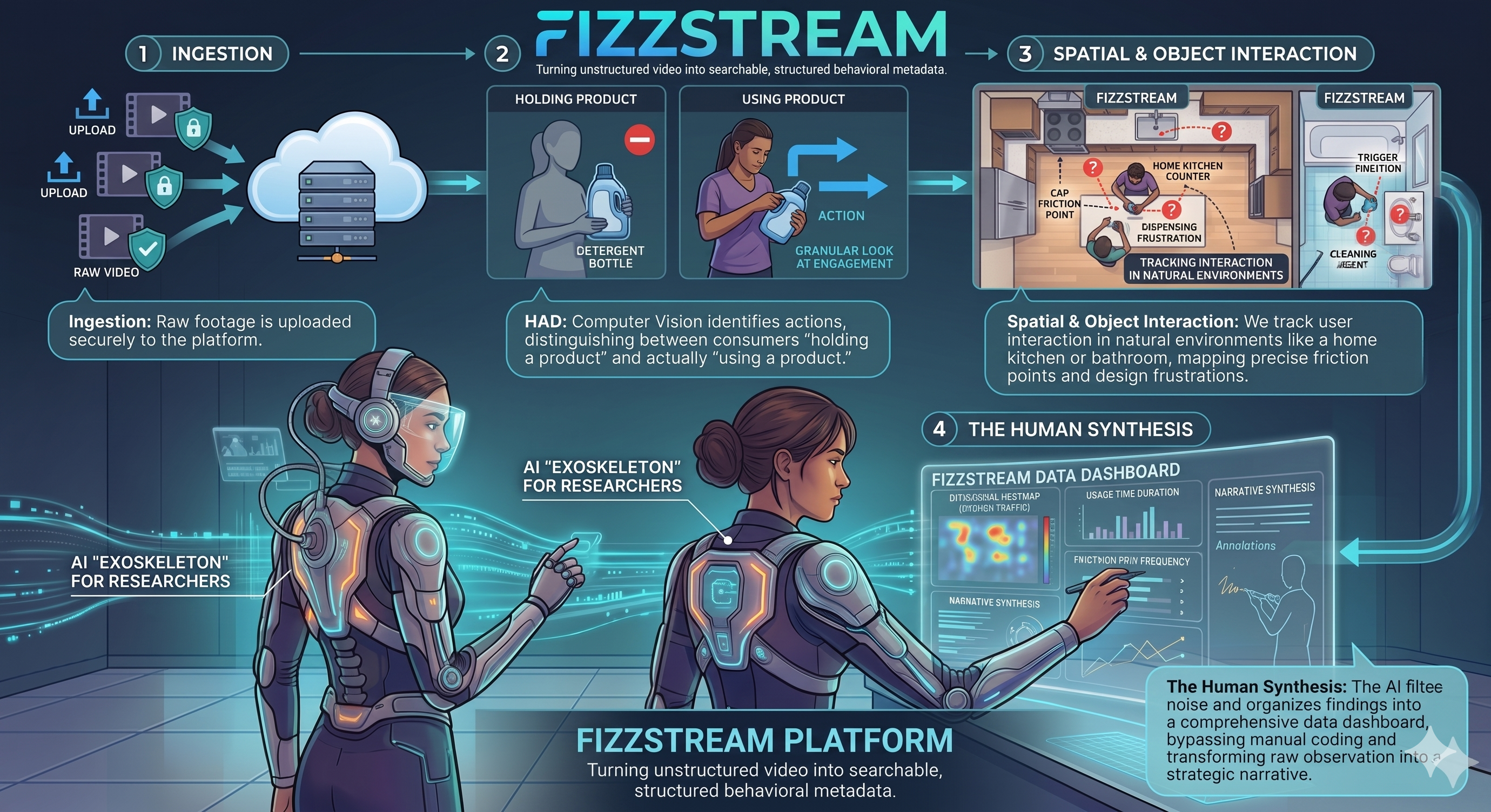
We don't believe AI replaces the researcher — we believe it scales them. By using FizzStream, our proprietary video analysis platform, we turn unstructured video into searchable, structured behavioral metadata.
How the Pipeline Works: From Raw Video to Strategic Insight
To demystify the "black box," here is how our AI processes qualitative data step by step:
Case Study: CPG Innovation in Dish Care#
Imagine a brand wants to understand why a new detergent cap is receiving negative reviews. Here's how the two approaches compare:
Traditional Method
A researcher manually watches 500 videos of people washing dishes. It takes 3 weeks. The conclusion: "the cap is hard to turn." Useful — but vague.
The Streamingo Way
Our AI analyzes 200 hours of video in 1 hour. It detects that 80% of users have wet, soapy hands when attempting to open the bottle, and that the torque required to open the cap exceeds the average grip strength available in those conditions.
Result
The brand receives a precise, technical engineering requirement — not a vague observation. The fix is specific, testable, and actionable. That's the difference between qualitative data and qualitative intelligence.
"The AI doesn't replace the researcher's empathy — it removes the noise so that empathy can do its best work."
Privacy First: Ethics in AI Research#
Qualitative research relies on participant trust. Streamingo addresses the primary privacy and ethical concerns of modern researchers head-on:
Data Sovereignty
Your data is yours. We provide automated tools to redact PII (Personally Identifiable Information) — including face-blurring and audio-redaction — before analysis even begins. Your footage is never used to train external models.
Bias Mitigation
Our models are trained on diverse datasets to ensure that Human Activity Detection remains accurate across different demographics, age groups, and environments. Equitable data is better data.
Conclusion: Don't Just Collect Data. Understand It.#
The goal of qualitative research has always been to understand human behavior. The bottleneck has never been the desire to understand — it has been the capacity to process what was collected.
With Streamingo's AI-powered tools, that capacity problem is solved. You can finally move at the speed of your consumer. Stop watching video and start uncovering the insights hiding inside it.