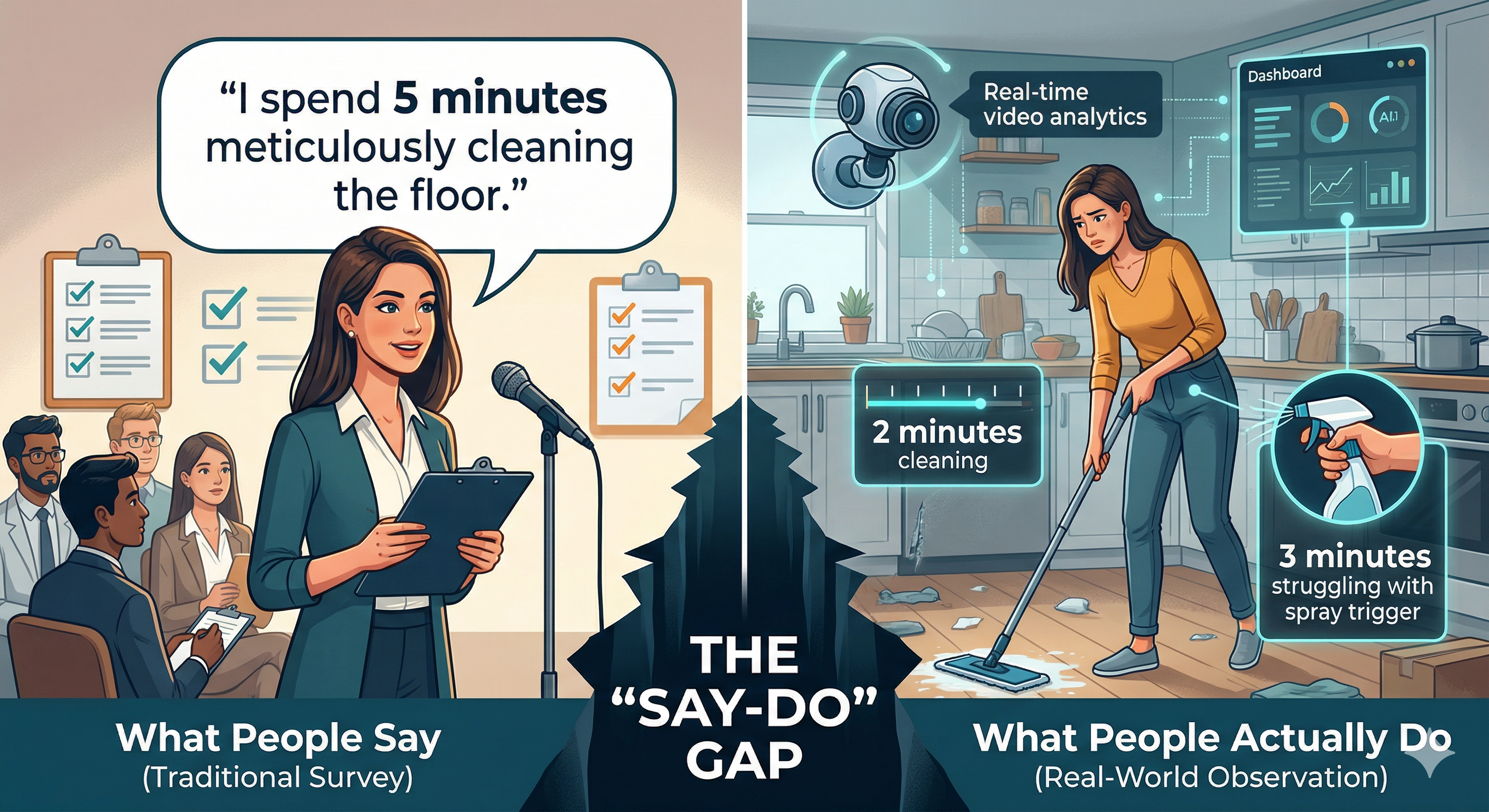
In the world of market research, we've spent decades asking people what they think, feel, and do. We rely on surveys to build our billion-dollar product roadmaps. But there is a fundamental flaw in this approach: Human beings are unreliable witnesses to their own lives.
This discrepancy is known as the "Say-Do" Gap. It's the chasm between a participant's survey response and their actual, real-world behavior. If your brand is making decisions based solely on what people say, you aren't just missing the full picture — you're likely looking at a different picture entirely.
The Psychology of the "Say-Do Gap"#
Most consumers aren't trying to mislead researchers. Instead, they are victims of two primary psychological hurdles:
Social Desirability Bias
We all want to look like the best versions of ourselves. In a survey, we report that we recycle every bottle, eat organic, and follow product instructions to the letter. In reality, shortcuts are taken constantly — and those shortcuts are where product improvements live.
Recall Bias
Our brains are not video recorders. We generalize. If you ask someone how they cleaned their kitchen yesterday, they will give you the "script" of how they usually clean, forgetting the specific moment they struggled with a leaky nozzle or skipped a step. Memory smooths out friction that data should be capturing.
Expectation vs. Reality: The Floor Cleaning Scenario#
Let's look at a classic example of how the "Say-Do" Gap manifests in a CPG (Consumer Packaged Goods) setting:
| The Source | The Data Point | Strategic Conclusion |
|---|---|---|
| Traditional Survey | I spent 5 minutes meticulously cleaning the floor. | The consumer is highly engaged with the cleaning process; focus on "scent" and "shine". |
| Video-Based Research | They spent 2 minutes cleaning and 3 minutes fighting with a jammed spray trigger. | The consumer is frustrated; focus on ergonomic packaging and mechanical reliability. |
The Reality Check
In this scenario, the survey tells the brand to focus on the formula (the "what"). The video tells the brand to fix the bottle (the "why"). Without the video, the brand might release a better-smelling product that consumers still hate because the bottle is broken.
The Strategic Cost of Ignoring the Gap#
When brands rely on self-reported data, they risk "addressing" problems that may not exist while ignoring the ones that do. This leads to:
Wasted R&D Dollars
Developing features that people say they want but never actually use — draining engineering budgets on low-impact improvements while real pain points go unaddressed.
Marketing Mismatch
Messaging that speaks to an "idealized" user rather than solving the real-world friction the "actual" user faces. Campaigns built on survey data often miss the emotional triggers that drive real purchase decisions.
Product Returns
"Ease of use" claims that fall apart the moment a consumer with wet or soapy hands tries to open the package — a gap between the promised experience and the delivered one that erodes brand trust rapidly.
Closing the Gap with AI and Video#
Historically, the "Say-Do" Gap was a necessary evil. Watching hundreds of hours of video to catch these discrepancies was too expensive and too slow.
That has changed. With AI-powered tools like Streamingo, we can now close the gap at scale. Our platform doesn't just record — it understands. By using Human Activity Detection (HAD), the AI can automatically flag every time a consumer pauses in frustration or struggles with a lid. It transforms hours of "silent" video into a data dashboard of objective, unbiased truth.
"Stop relying on what people claim to do — start building for what they actually do."
Stop Guessing. Start Observing.#
Qualitative research is our only lens into human empathy, but that empathy must be grounded in reality. By moving from surveys to automated video analysis, you stop relying on what people claim to do and start building for what they actually do.
The brands that close the Say-Do Gap today are the ones who will ship products consumers love tomorrow — not because they asked better questions, but because they finally started watching the answers.